With “Playfulness” you can succeed in the digital world
The more complex today’s connected world becomes and the faster it changes, the more outdated rigid organizational patterns and approaches to working life are. At a time when change is the only constant factor, flexibility and creativity are becoming increasingly important. Sustainable companies, therefore, give their employees more leeway to promote creative processes that make innovations possible in the first place. This requires a new style of leadership that not only allows a playful approach to complex problems, but also explicitly encourages it.

For a long time, confronting the world and its challenges playfully was, at best, regarded as a privilege of children, who, from the different games they play, acquire the skills and knowledge with which they can later compete in the “seriousness of life”.
 |  |
|---|
In the adult world, on the other hand—and in the executive levels at least once in a while—this lightness was long underestimated and considered childish or the peculiarity of unreliable people. In the meantime, however, it has become clear that a certain playfulness in the jungle of the digital revolution can secure survival. What’s more, this lightheartedness becomes a competitive advantage under the trend term “playfulness” when it comes to identifying which company can most effectively tap the creative potential of its employees. Even in the professional world of tomorrow, fixed structures and predetermined processes will remain indispensable. However, they will have to be loosened to such an extent that the working person has enough room to develop his or her creativity. This is the only way to create a corporate culture in which the employee can give his best performance—not because his boss is threateningly on his back, but because he is absorbed in his job and enjoys pulling out all the stops.
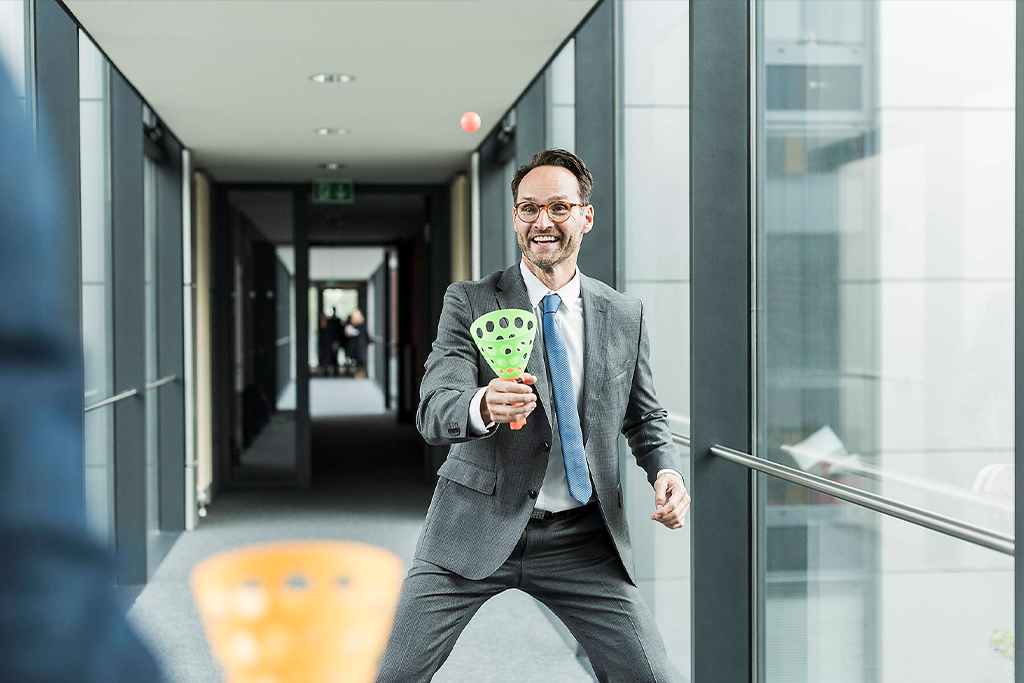
This requires management to view the employee differently, away from the “old” world of work in which the employee has to “function” before all else, toward a new way of working together in the company with less “control” and more possibilities for the self-organization of each individual. “Playfulness” plays a decisive part in achieving this goal. It is only a playful approach to solving complex problems and tasks that makes us open to new ideas, to looking to the left and right of well-trodden paths, to finding a playfulness that enables us to discover our own knowledge instead of hoping for new rules, that ultimately leads to innovations and, through them, possibly even to revolutionary innovations in any field. The ideal of this “beautiful new working world”—because we all know that it is not yet a reality everywhere—certainly has parallels to virtual game worlds.

And, undoubtedly, the generation of “digital natives” with their experience in this field will sooner or later be increasingly involved in shaping and transforming working life in this direction. To the extent that fixed rules and routines are increasingly being watered down, the boundaries between work and leisure time are becoming blurred. It’s quite clear that playful elements from the leisure sector are making their way into the offices — not because there are silly, big children at work here, but because many companies are slowly but surely realizing that satisfied employees are more committed to what they do.

Modern employee management will, therefore, function less and less according to the principle of “boss jumps, and everyone asks how high,” but instead it will be more and more important to create and promote a sense of togetherness as a manager of a team in which the individual team members are loose as they pass the ball, so to speak.

This also means that no one has to be afraid if they drop the ball. Failure must be possible as long as it is not the rule and must be seen as a necessary step on the way to the goal instead of being tainted with the flaw of failure. Pioneers in terms of playfulness are undoubtedly the companies in which creativity is the driving force behind their employees and the most important quality feature of their products.

What company exhibits this better than Westend61? Westend61’s business model was only made possible by the new possibilities of the digital revolution, and the company had to react again and again to the constant change of the networking world in order to remain competitive. The ingenuity of Westend61’s marketing strategy goes hand in hand with the creativity of the photographers who cooperate with Westend61—a very fruitful combination, as you can see when looking at the portfolio. Good pictures, especially, which delight the eye and generate emotions for the viewer, can never be the result of standardized procedures and bitter seriousness. After all, they are the result of unbridled playfulness in dealing with color, light, and shadows. Their variety of motifs documents all facets of the great game of life.